
Hygiene training according to LMHV §4 – obligations, content and legal requirements for food businesses

Hygiene training according to Section 4 of the Food Hygiene Regulation (LMHV) This is one of the fundamental obligations of every food business in Germany. Nevertheless, uncertainties repeatedly arise in practice regarding its scope, frequency, and concrete implementation.
Many businesses routinely implement hygiene training without fully understanding the legal requirements. Others underestimate the demands and risk complaints during official inspections or deviations from regulations. Certification audits.
This guide explains the legal basis, the parties obligated, the required content, and practical requirements for documentation and organization.
Table of contents
Legal basis for hygiene training according to §4 LMHV
The Food Hygiene Regulation transposes European hygiene standards into national law. The most important aspect is... Regulation (EC) No. 852/2004 about food hygiene.
§4 LMHV obliges Food businesses are required to ensure that people handling food are supervised, instructed or trained according to their duties.
The regulation pursues a clear goal: food safety must not depend on chance. It presupposes that employees can recognize hygiene risks and act correctly.
The legislator deliberately avoids specifying rigid training intervals or standardized content. Instead, a risk-oriented approach is required. The training must be tailored to the nature, scope, and potential hazards of the respective activity.
European legal framework: Regulation (EC) No 852/2004
Hygiene training according to §4 LMHV is not a purely national regulation, but is directly related to the Regulation (EC) No. 852/2004 on food hygiene. This EU regulation forms the central legal framework for food safety within the European Union.
Article 4 of the regulation obliges food businesses to comply with general hygiene requirements. This is specified in more detail in Annex II Chapter XII of Regulation (EC) No 852/2004. It explicitly states that food business operators must ensure that People who handle food must be supervised and instructed according to their duties, as well as Employees are adequately trained in the area of HACCP.
Implementation of Annex II Chapter XII of Regulation (EC) No 852/2004
Annex II Chapter XII of Regulation (EC) No 852/2004 obliges food businesses to ensure that their staff have the necessary hygiene competence. Section 4 of the LMHV (German Food Hygiene Regulation) incorporates this obligation into national law and specifies it further. for practical application in German companies.
While the EU regulation sets the framework, Section 4 of the German Food Hygiene Regulation (LMHV) specifies the organizational responsibility of the food business operator for training, instruction, and monitoring. The LMHV is therefore Implementing law for the EU regulation and should not be considered in isolation.
Obligated companies within the meaning of the LMHV
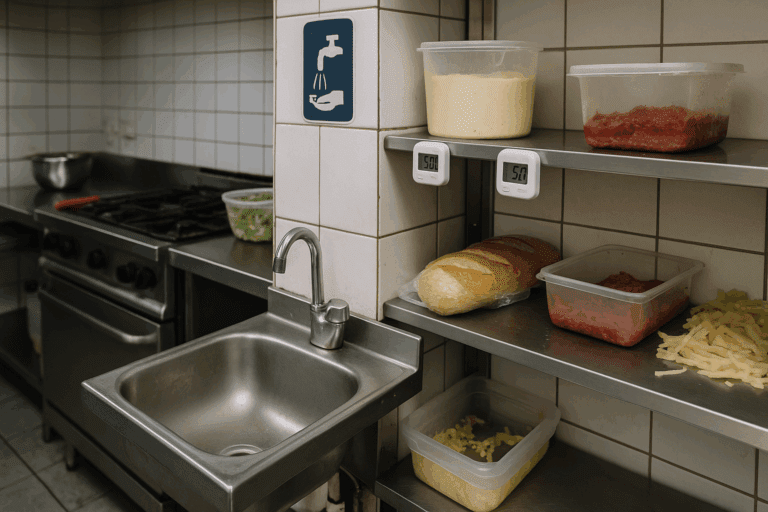
All food businesses are obligated to comply. The term "food business" is broadly defined. It encompasses any establishment, regardless of size, that carries out an activity related to the production, processing, or distribution of food.
These include, among others:
- Food manufacturers
- Processing plants
- Bakeries and butcher shops
- Restaurants
- Catering company
- commercial kitchens
- Retailer with food sales
- Online retailer with food delivery
- Logistics companies with food contact
Obligated persons within a company
The training requirement applies not only to individual employees, but to all persons who handle food or have an impact on food safety. This includes:- Production staff
- Kitchen and service staff
- Warehouse and shipping staff
- Cleaning staff in sensitive areas
- Temporary workers and seasonal workers
- Trainees
- Managers with production responsibility

Distinction from instruction according to the Infection Protection Act
A common practical error is confusing hygiene training according to the German Food Hygiene Regulation (LMHV) with the... Instruction according to §43 of the Infection Protection Act (IfSG). The instruction required under the Infection Protection Act (IfSG) is conducted by the public health department or an authorized medical body. It covers health risks posed by communicable diseases and is a prerequisite for working with food.
the Hygiene training according to the German Food Hygiene Regulation (LMHV), on the other hand, is an in-house measure.. It encompasses organizational, procedural, and hygiene requirements in everyday work. Both regulations pursue different objectives and are mandatory independently of each other.
Risk-oriented approach to hygiene training
§4 LMHV requires a Training "appropriate to the activity"“This means that the content and intensity of the training must be tailored to the individual risk.”.
An employee in raw material receiving needs different priorities than a person in final packaging or in the service area.
A risk-oriented approach taken into account:
- Type of food
- Perishability
- Production process
- Contact intensity
- Potential hazards
The training must be based on the company's HACCP concept.
Contents of a hygiene training course according to LMHV §4
Basics of personal hygiene
This includes requirements for clean work clothes, hand hygiene, a ban on jewelry, behavior in case of illness, and reporting obligations in case of symptoms.Operational hygiene and production hygiene
Cleaning and disinfection measures, zoning concepts, separation of raw and finished goods, temperature monitoring and pest prevention are key components.HACCP principles
Employees must understand what dangers exist in the respective production process and how critical control points are monitored.Documentation requirements
The importance of records, checklists, and control protocols must be conveyed.Product-specific risks
Depending on the industry, additional topics may be required, such as allergen management or foreign body prevention.Training frequency and repetition intervals
The law does not specify a fixed interval for refresher training. However, authorities and certification bodies expect regular instruction.
In practice, the following structure has proven effective:
- Initial training before starting work
- Repeat at least every 12 months
- Additional training for process changes
- Retraining in case of identified deficiencies
Traceability is crucial.
Documentation requirements and verification requirements
- Date of training
- Training content
- duration
- Participant list
- Signatures
- Name and signature of the person providing the training
The person providing the training must be demonstrably qualified to conduct the training, e.g. through education, studies, training courses and experience.
Missing or incomplete documentation may be considered a violation.

Official inspections and possible consequences
During food inspections by the responsible authority, it is regularly checked whether training courses have been carried out properly.
Possible consequences for violations include:
- Requirements for retraining
- Fines
- Warnings
- negative entries in the inspection report
- Impact on certifications
In serious cases, a Inadequate training as organizational negligence will be evaluated.
Authorities not only review training courses based on the German Food Hygiene Regulation (LMHV), but also with regard to compliance with the... Regulation (EC) No. 852/2004. Violations can therefore be considered both as violations of national administrative offense law and as violations of directly applicable EU law.
Hygiene training in the context of certifications
Standards such as IFS, BRCGS or FSSC 22000 place more stringent requirements on training systems. Formal instruction alone is not sufficient.
The following are required:
- structured training plans
- Competency assessments
- Effectiveness controls
- continuous update
The LMHV (German Food Hygiene Regulation) merely represents the legal minimum requirement.
Management responsibility
The responsibility for ensuring compliance with training requirements lies with company management. Delegation is possible, but does not absolve them of overall responsibility.
A functioning training system is part of a company's duty of care.
Hygiene training for external service providers
External service providers working in hygiene-relevant areas must also be trained.
These include, for example:
- external cleaning teams
- Maintenance companies
- pest controller
- technical service teams
Responsibilities should be contractually defined. However, the client remains obligated to ensure that hygiene requirements are met.
Digital and in-house training formats
Hygiene training can be conducted in person, digitally, or in a hybrid format. The crucial factors are the quality of knowledge transfer and the verifiability of the training.
Digital training offers advantages in terms of documentation and repeatability. In-person training allows for intensive interaction.
The choice of format should orient towards operational needs.
Relationship between hygiene training and HACCP system
Regulation (EC) No 852/2004 obliges food businesses in Article 5 to introduce, implement and maintain a HACCP-based self-monitoring system.
Effective implementation of the HACCP concept is impossible without trained personnel. The training requirement according to §4 of the German Food Hygiene Regulation (LMHV) is therefore directly and functionally linked to Article 5 of the EU Regulation.
Employees must:
- Understanding the dangers
- Identify critical control points
- Perform monitoring measures correctly
- Report deviations
Hygiene training ensures that the HACCP system not only exists formally, but is also applied in practice.
Summary of the obligation according to §4 LMHV
- This is done in a risk-oriented manner
- are carried out regularly
- be documented
- be adapted to operational conditions
Companies that systematically organize training reduce liability risks, strengthen their food safety, and increase their auditability.
The legal minimum requirement forms the basis for further quality and certification standards.
Our customers trust in practical training LMS
Practical training LMS is highly recommended
Working with the Praxistrainings-LMS team is always flexible, personalized, and to the point. I particularly appreciate the open exchange and the opportunity to address our specific needs directly – it's simply fun and ensures that we take away truly practical solutions.
Robin, QM Manager, relies on in-house training from Praxistrainings-LMS for his team.
Very well organized and conducted training with lots of practical relevance. The exchange was very enriching and my expectations were met. Big praise also goes to the speakers who moderated the training brilliantly.

Very well organized and conducted training with lots of practical relevance. The exchange was very enriching and my expectations were met. Big praise also goes to the speakers who moderated the training brilliantly.
The training is practical and conveys all the important content on the subject of declaration of conformity. What I particularly liked is that the training is also suitable for beginners. You are well introduced to the topic so that you can quickly follow and understand the deeper and more complex content. All questions are answered in detail and directly during the training.
Ms. Ziegler is a very experienced and friendly trainer. Your professional career is impressive. In the run-up to the training, she looked at my HACCP concept and gave me specific feedback and many valuable tips for implementation. In summary, the training was very successful for me and I recommend it at any time.
Trainers from practice
Our trainers come from the industry – for example, former managers, auditors, consultants.
We speak plainly, work on an equal footing, and continually update our documents. Many Years of experience in QM & food safety, ksmall training groups, high exchange, kcontinuous improvement & modern working methods

Jennifer Ziegler
owner
I make sure that technical content is conveyed in a practical, complete and easily digestible way. This is how I combine technical content with learning methodology. And ensure lasting learning success.

Ben Buhlman
Technical expert IFS
With me you benefit from the experience of more than 20 years in the food industry. The Safe handling of declarations of conformity is one of my focus topics.

dr Andrea Dreusch
SUBJECT EXPERT
microbiology and consulting are my strengths.
In this way, I strengthen your ability to act – in customer projects and as a trainer.
Knowledge & Resources (free)
We offer a download area with checklists & templates, podcasts, specialist articles, updates and a community exchange (LinkedIn group)



Frequently asked questions about LMHV §4
Who is required to attend hygiene training according to LMHV §4?
How often must hygiene training be conducted according to the German Food Hygiene Regulation (LMHV)?
Is the instruction required under the Infection Protection Act sufficient?
Do temporary workers and those in marginal employment also need to be trained?
What content should a hygiene training course include?
Does the hygiene training need to be documented?
Does the training requirement also apply to external service providers?
What penalties are imposed for failing to receive hygiene training?
Is online hygiene training permissible according to the German Food Hygiene Regulation (LMHV)?
Who is authorized to conduct hygiene training?
Our successes – quality that convinces!
4+ years
Since the founding of Praxistrainings-LMS
20+ trainers
with industry knowledge & expertise
6500+ participants
in training & e-learning
30+ training courses & e-learnings
individual & practical
Ready to take the next step?
Do you want to provide your teams with practical training, confidently pass audits, and establish a strong food safety culture? We support you – quickly, transparently, and practically.
 EN
EN  DE
DE  AR
AR  BG
BG  CS
CS  FR
FR  EL
EL  HU
HU  IT
IT  PL
PL  RO
RO  RU
RU  ES
ES  TR
TR  UK
UK  VI
VI  ZH
ZH  HR
HR