
AI in quality management: Simplifying documentation and efficiently supporting processes

the Requirements in quality management are constantly increasing.Documentation requirements are increasing, regulatory requirements are becoming more complex, and audits demand complete traceability. At the same time, companies must work efficiently and make information quickly available.
Artificial intelligence in quality management helps companies to make existing processes simpler, more structured, and more efficient. The goal is not to replace functioning quality management systems, but rather to specifically relieve the workload of specialists in their daily tasks.
Especially in the Document creation, audit preparation and evaluation of large amounts of information AI offers significant advantages. Content can be structured more quickly, documentation standardized, and information processed more easily. This frees up quality management managers to dedicate more time to technical and strategic tasks.
Especially in the food industry, AI helps to implement complex requirements safely and transparently – from HACCP documentation to audit preparation.
Table of contents
AI in quality management: What companies really need today
Search queries related to AI in quality management clearly show which topics companies are currently concerned with:
- AI in Quality Management Training
- AI in Quality Management
- AI in quality assurance
- AI Audit
- AI in auditing
- AI-supported quality management
- AI in QM
The focus is less on the complete automation of quality processes, but rather on how AI can meaningfully support existing QM structures.
Companies today are primarily looking for:
- practical AI training
- specific application possibilities
- Support with documentation and audits
- more efficient QM processes
- Understandable AI basics for employees and managers
What does AI mean in quality management?
Artificial intelligence in quality management describes the use of digital systems that support employees in analyzing, structuring, and processing information.
AI meaningfully complements existing QM processes and is particularly helpful in the following areas:
- To create documentation more efficiently
- to evaluate information faster
- To simplify recurring tasks
- Making knowledge available in a structured way
- better prepare for audits
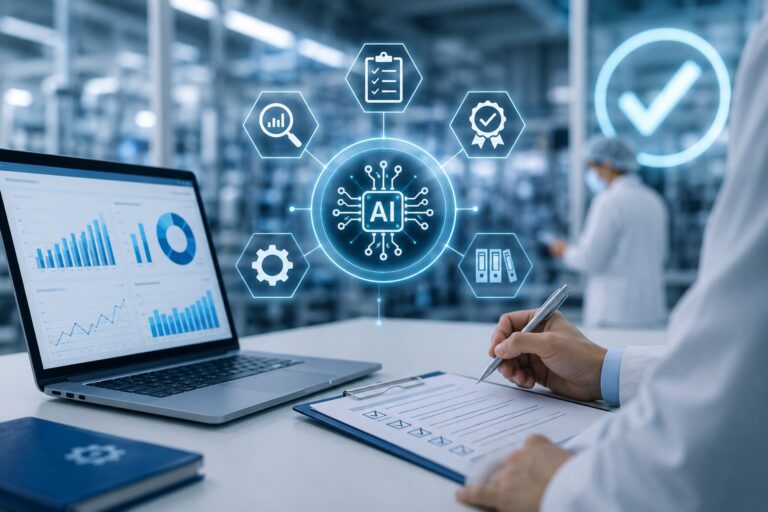
AI in quality management explained simply
AI helps quality managers process large amounts of information faster and implement documentation processes more efficiently.
Real-world examples:
- Summaries of audit reports
- Support with SOP and process documentation
- Formulation aids for QM documents
- structured evaluation of deviations
- faster processing of audit-relevant information
This allows employees to work more efficiently without having to fundamentally change existing specialist processes.
AI-supported quality management to support existing processes
Many companies already have established quality management systems and structured processes. AI complements these systems effectively and helps to make existing processes more efficient.
AI provides particular support in:
- with high documentation effort
- for recurring administrative tasks
- in the structured processing of large amounts of information
- in preparation for audits and certifications
The professional assessment and decision-making remains with the responsible employees.
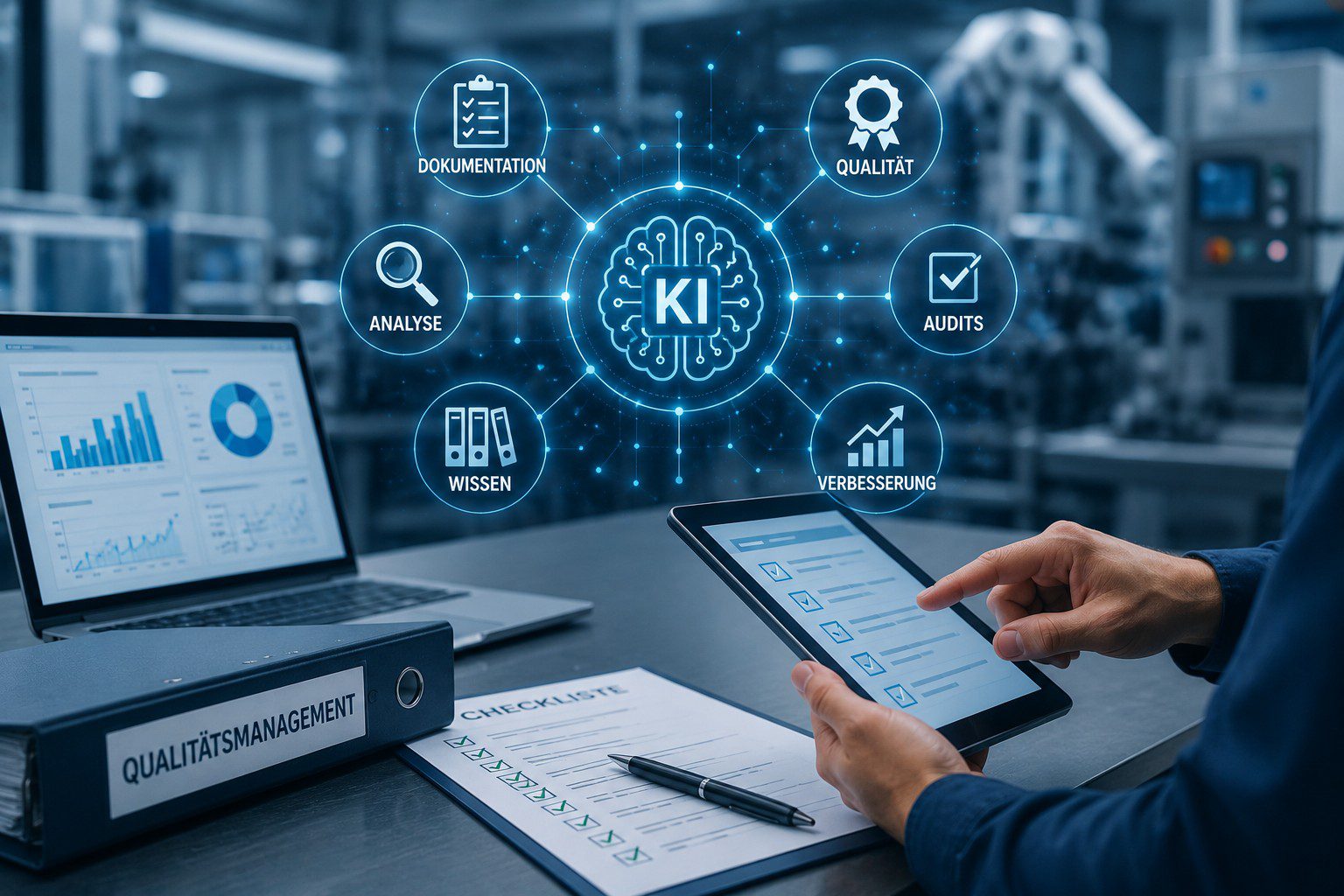
AI in quality assurance: Practical applications
Support with documentation and SOP creation
Creating and maintaining documentation is one of the most time-consuming tasks in quality management.
AI can help with this:
- To structure documents uniformly
- To formulate content more quickly
- to summarize existing documentation
- To efficiently prepare SOPs and work instructions
- To implement templates and standards consistently
This significantly reduces the administrative burden.
AI simplifies audits and audit preparation
Many companies are specifically looking for solutions related to AI auditing and AI in auditing. The reason: Audits often generate a high level of organizational and documentation effort.
AI systems help with this:
- Finding audit-relevant information more quickly
- To provide documents in a structured manner
- To clearly evaluate deviations
- To document measures in a comprehensible manner
- Efficiently preparing information for auditors
This simplifies preparation and improves the clarity of existing QM documents.
Knowledge management and information processing
In many companies, quality management knowledge is distributed across different systems, documents, and employees.
AI provides support in this process:
- To process information centrally
- To make content more quickly accessible
- to create summaries
- To efficiently answer recurring questions
- to make better use of internal knowledge
This ensures that knowledge is preserved in the long term and made more readily available.
Support with risk analyses and evaluations
AI can also support quality management managers in analyzing large amounts of data. Examples:
- Evaluation of deviations
- Analysis of recurring error patterns
- Support with HACCP documentation
- Structuring of complaint data
- Preparation of supplier evaluations
The systems provide support and transparency – the professional evaluation remains the responsibility of those in charge.
AI in quality management in the food industry
Especially in the food industry, the demands on documentation, traceability, and auditability are constantly increasing. AI helps companies to implement existing processes more efficiently and to make better use of information.Support with HACCP and Food Safety
AI can help companies with:
- To structure HACCP documentation more effectively
- To present checkpoints more clearly
- To document risks in a comprehensible manner
- to evaluate information faster
- Efficiently provide audit documents
This makes it easier to organize and document existing food safety processes.
Using AI effectively in the food industry
The search queries show that companies are increasingly looking for specific applications of AI in the food industry.
Particularly relevant are:
- digital documentation
- Audit preparation
- structured risk analyses
- Knowledge management
- more efficient QM processes
- AI training in quality management
This is precisely where AI offers significant practical benefits for quality management departments.
AI training and further education in quality management
Many companies are specifically looking for:
- AI training
- AI Basics Training
- AI training
- AI Basics Training
The need for understandable and practical training courses is increasing significantly.
The following is important:
- understandable communication instead of technical theory
- concrete practical examples
- direct implementation in everyday QM practice
- Focus on documentation, audits and information processing
Training courses that present AI not as a replacement, but as practical support in quality management are particularly successful.
Advantages of AI in quality management
Less manual effort
Many recurring tasks can be handled much more efficiently:
- Documentation
- Summaries
- Information processing
- Research in QM documents
- Structuring content
This leaves more time for professional activities.
Faster information processing
AI helps to evaluate large amounts of information more quickly and present it clearly.
This improves:
- the clarity
- the reaction rate
- traceability
- internal communication
Better support in everyday work
AI does not replace quality managers, but supports them in their daily work.
This is particularly helpful:
- with high documentation workload
- in complex audit requirements
- from many different sources of information
- in standardized routine tasks
Challenges in the introduction of AI in quality management
In order for AI to be used effectively, companies must define clear processes and meaningful areas of application.
Data quality and structuring
For AI to work efficiently, it needs information:
- structured
- understandable
- current
- be consistently documented
A good data basis remains the foundation of successful QM work.
Training and acceptance
Employees should understand:
- how AI is used
- which tasks are supported
- what limitations the systems have
- how to properly evaluate results
AI works particularly well when expertise and digital support are combined effectively.
AI as a support, not a replacement
AI does not replace professional expertise or responsible decisions.
She provides support in this:
- To process information more efficiently
- To reduce documentation effort
- To make processes more transparent
- to meaningfully complement existing QM systems
People remain a central component of successful quality management.
Our customers trust in practical training LMS
Practical training LMS is highly recommended
Working with the Praxistrainings-LMS team is always flexible, personalized, and to the point. I particularly appreciate the open exchange and the opportunity to address our specific needs directly – it's simply fun and ensures that we take away truly practical solutions.
Robin, QM Manager, relies on in-house training from Praxistrainings-LMS for his team.
Very well organized and conducted training with lots of practical relevance. The exchange was very enriching and my expectations were met. Big praise also goes to the speakers who moderated the training brilliantly.

Very well organized and conducted training with lots of practical relevance. The exchange was very enriching and my expectations were met. Big praise also goes to the speakers who moderated the training brilliantly.
The training is practical and conveys all the important content on the subject of declaration of conformity. What I particularly liked is that the training is also suitable for beginners. You are well introduced to the topic so that you can quickly follow and understand the deeper and more complex content. All questions are answered in detail and directly during the training.
Ms. Ziegler is a very experienced and friendly trainer. Your professional career is impressive. In the run-up to the training, she looked at my HACCP concept and gave me specific feedback and many valuable tips for implementation. In summary, the training was very successful for me and I recommend it at any time.
Trainers from practice
Our trainers come from the industry – for example, former managers, auditors, consultants.
We speak plainly, work on an equal footing, and continually update our documents. Many Years of experience in QM & food safety, ksmall training groups, high exchange, kcontinuous improvement & modern working methods

Jennifer Ziegler
owner
I make sure that technical content is conveyed in a practical, complete and easily digestible way. This is how I combine technical content with learning methodology. And ensure lasting learning success.

Ben Buhlman
Technical expert IFS
With me you benefit from the experience of more than 20 years in the food industry. The Safe handling of declarations of conformity is one of my focus topics.

dr Andrea Dreusch
SUBJECT EXPERT
microbiology and consulting are my strengths.
In this way, I strengthen your ability to act – in customer projects and as a trainer.
Knowledge & Resources (free)
We offer a download area with checklists & templates, podcasts, specialist articles, updates and a community exchange (LinkedIn group)



Frequently asked questions about quality management in the food industry
What is meant by AI in quality management?
How is AI used in quality assurance?
AI in quality assurance supports companies in areas including:
- Documentation
- Evaluations
- Audit preparations
- Risk analyses
- Knowledge management
What advantages does AI auditing offer companies?
Is AI in quality management also useful for small companies?
What role does AI play in the food industry?
Why are AI training courses becoming increasingly important in quality management?
Our successes – quality that convinces!
4+ years
Since the founding of Praxistrainings-LMS
20+ trainers
with industry knowledge & expertise
6500+ participants
in training & e-learning
30+ training courses & e-learnings
individual & practical
Quality management as a success factor
Quality management is indispensable in the food industry. It ensures safe products, stable processes, and trust among customers and partners.
Companies that regularly train their employees and consistently implement their systems create the foundation for long-term success and sustainable growth.


