
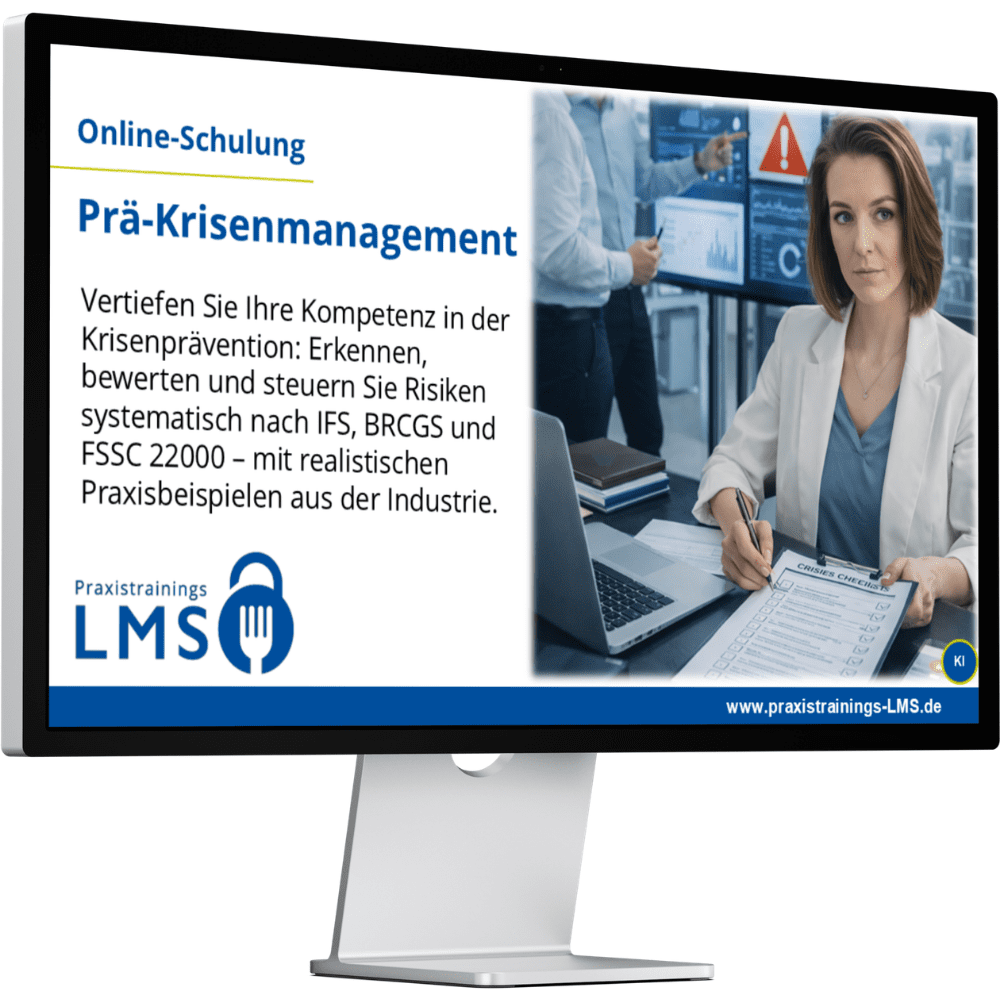
Strategic pre-crisis management: How to prevent crises before they arise
Professional crisis management means not only reacting, but acting proactively. This advanced module delves deeper into the preventive elements of effective crisis management systems.
From complaint to possible recall – in many cases, the correct assessment at the right moment determines the further course of action.
In this online training, you will learn to identify risks early, classify them in a legally sound manner, and assess them confidently before a deviation turns into a crisis.
The content combines legal principles, toxicological assessment, and practical decision-making logic – oriented towards the requirements of:
- IFS Food Version 8
- IFS Broker 3.2
- BRCGS
- FSSC 22000
- EU Basic Regulation (Articles 14 & 19)
The training can be booked individually or as an in-depth advanced module to the training. "crisis management“.
Our crisis management training is:
- Applicable: with clear decision-making structures for emergencies
- Practical: with realistic case studies and group work
- Standard-compliant: taking into account current requirements from IFS, BRCGS and FSSC 22000
- From practitioners: with many years of experience in quality management and crisis management
Contact: info@praxistrainings-LMS.de or 05152-7800574
Book now:
- 3.5 hours of online training
- Requirements from laws and standards
- practical implementation in the company
Next available date:
- 19.06.2026, 09:00-12:30
- Further dates/in-house appointments available upon request at: info@praxistrainings-lms.de, English possible
Booking for companies:
only 450 €
Training content: Pre-crisis management
1. Identify risks early – figures, data, facts
- Typical main risks for food distributors
- Contaminants, residues, foreign bodies – clear distinction between terms
- Keep an eye on early warning systems and regulatory developments
- Risk assessment based on toxicological parameters (e.g. ADI, ARfD)
2. Legal basics, compact and practical
- Regulation (EC) No. 178/2002 (Art. 14 & 19)
- Food and Feed Code (LFGB)
- Maximum residue limits Regulation (396/2005)
- Contaminants Regulation (EU 2023/915)
- Regulation (EC) 2073/2005 (microbiological criteria)
- Information and reporting obligations towards authorities and certifiers
Practical focus: When is there actually a recall obligation – and when is there not?
3. Complaint ≠ Recall
Not every deviation warrants a recall. We consider:
- Microbiological findings
- Labeling defects
- foreign body
- Exceedances of limit values
Decision logic:
- Is there a health risk?
- Is there any deception involved?
- Is the product not marketable?
- Traffic ban, withdrawal or recall?
- Risk-based overall assessment
Exercise: Evaluation of a realistic case study
4. Mastering interactions with authorities with confidence
- Preparation in "quiet times"„
- Typical process of contacting a government agency
- Rights and obligations of the company
- Do's and Don'ts for First Contact
- Internal and external communication strategy
- Dealing with time pressure
With practical examples from real conversation situations.
5. Workshop: A critical case?
In groups, you will work on a realistic scenario, e.g.:
- Detection of a pesticide residue
- Undeclared ingredient
- Industrial customer complaint
Task:
- Assess risk
- Define action
- Preparing communication with authorities or customers
- Provide a professional justification for the decision

A notice:
The training can be combined with the Crisis management training Both formats can be booked individually or as an in-depth complete package.
Book this training course and the crisis management training course together conveniently., for €799 plus VAT::
Benefits of our online training on pre-crisis management
By experts
Practical trainers
Small groups
Max. 12 people
On-line
No travel times
documents
Directly as PDF
For groups*
special conditions
company
In-house possible
* For groups: Sign up below info@praxistrainings-lms.deto receive an individual offer.
** For companies: We also offer our training courses in-house by arrangement. Request to: info@praxistrainings-lms.de.
Target group of the training course on pre-crisis management
This training is aimed particularly at:
- Experienced crisis managers
- QM management
- Food safety officers
- Management with strategic responsibility
- Participants of the "Crisis Management" module„
This module is suitable both as an advanced training course for experienced managers and as a follow-up training course after the basic module.
Benefits of crisis management training
✔️ Strategic view of crisis prevention
✔️ Safety in border and grey areas
✔️ Sound decision architecture
✔️ Standards-compliant and legally sound assessment of complex situations
✔️ Strengthening entrepreneurial capacity
✔️ Sustainable reduction of recall risks
Frequently asked questions about crisis management training
- An appointment lasting approximately 3.5 hours (including breaks)
- Important: Ensure an interference-free environment and stable Internet access from the PC. Camera and headset are required.
After completing the training, you will receive a certificate for successful participation in the Pre-Crisis Management training.
Book directly through this website or ask one Booking on account among info@praxistrainings-lms.de on.
If you would like to book the training for several people, please send us an email info@praxistrainings-lms.de. We are also happy to offer the training as an in-house training course.
Your experts for pre-crisis management

Claus-Michael Brieber
Senior LMS Expert
Dipl.-Ing. Claus-Michael Brieber is an experienced food technologist specializing in food safety, contaminants, residues and has held senior positions in large companies for many years.
Booking on account:
Would you like to book on account as a company? No problem!
 EN
EN  DE
DE  AR
AR  BG
BG  CS
CS  FR
FR  EL
EL  HU
HU  IT
IT  PL
PL  RO
RO  RU
RU  ES
ES  TR
TR  UK
UK  VI
VI  ZH
ZH  HR
HR
Reviews
There are no reviews yet.