
Crisis management training in the food industry (online)
Crisis management training for the food industry equips you with the necessary skills to act more safely, systematically, and legally in critical situations. You will learn how to establish an effective crisis management system and professionally manage product recalls.
This online training is specifically aimed at companies in the food industry or packaging industry that want to improve their processes in the areas of crisis management in the food industry and food recall management.
Online training in crisis management: content and procedure
A recall is rarely planned – and is a management task under time pressure. Massive repercussions for the company are possible.
A product recall in the food or packaging industry demands swift, decisive action. In practice, companies rarely fail due to a lack of processes. They fail due to uncertainty, unclear responsibilities, and inadequate leadership.
In this training you will learn how to:
- Know the requirements from standards (IFS, BRCGS, FSSC)
- Recognizing crises
- Making decisions under time pressure
- Assess risks correctly
- Properly build and effectively manage your crisis team
- Safely meet legal requirements
You will receive a clear structure that will provide you with guidance even in critical situations.
- Applicable: Clear decision-making logic for emergencies
- Practical: Real-world scenarios from the food industry
- Standard-compliant: IFS Food, IFS Broker, BRCGS and FSSC 22000
- From practitioners: A compact 4 hours with maximum benefit
Contact: info@praxistrainings-LMS.de or 05152-7800574
Book now:
- 4-hour online training
- Requirements from laws and standards
- practical implementation in the company
Next available date:
- 15.06.2026, 09:00-13:00
- Upon request to: info@praxistrainings-lms.de
Booking for companies:
only 450 €
Content of the crisis management training in the food industry
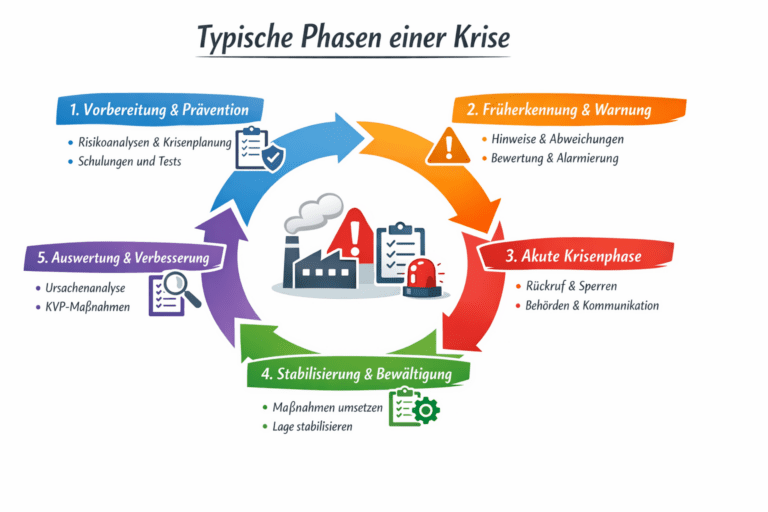
1. Preparation & Prevention
They create the basis for effective crisis management in the food industry.
- Requirements from IFS Food, BRCGS and FSSC 22000
- Legal basis (EU Basic Regulation Art. 14 & 19)
- Establishing a crisis management system
- Definition of escalation criteria
- Creation of crisis plans and contact lists
- Content for conducting recall exercises
Goal: You act in a prepared manner before a crisis arises.
2. Early detection & warning phase
They learn to recognize risks early and assess them correctly.
- Definition of a crisis according to standards
- Assessment of deviations and suspected cases
- Risk assessment for health hazards
- Decision-making: Observe, block, or escalate
- Documentation of the initial assessment
Goal: You make well-informed decisions at the right moment.
3. Acute crisis phase
They manage product recalls of food products safely and in a structured manner.
- Withdrawal vs. recall – acting in compliance with the law
- Reporting obligations to authorities
- Information from the certification body
- Immediate measures & product blocking
- Batch separation & traceability
- Internal and external communication
Goal: You maintain control and minimize damage.
4. Stabilization & Coping
They will guide your company safely through the crisis.
- Role and management of the crisis team
- Communication with customers, trade and the public
- Cooperation with authorities
- Ongoing risk assessment
- Ensuring delivery capability
Goal: They stabilize the situation and secure trust.
5. Evaluation & Improvement
They are using the crisis for sustainable optimization.
- Root Cause Analysis (RCA)
- Evaluation of the effectiveness of crisis management
- Derivation of corrective and preventive measures
- Documentation for audit and management review
- Strengthening the food safety culture
Goal: You prevent repetitions and improve your processes.
A notice:
The training can be combined with the Pre-crisis management training Both formats can be booked individually or as an in-depth and discounted complete package.
Book this training course and the pre-crisis management training course together, for €799 plus VAT:
What is crisis management in the food industry?
Crisis management in the food industry refers to all structured measures that a company takes to respond to security-related incidents in order to minimize risks to consumers, brand and supply chain. The goal is to identify dangers early, assess them quickly, and take controlled action.
Effective crisis management protects consumers, fulfills legal requirements, and ensures the company's ability to act in an emergency. Our Training courses for the food industry They are therefore essential to successfully prevent crises.
Online training: Crisis management in the food industry
In the context of the food industry, a crisis exists when a product poses a potential or actual health risk or violates regulatory requirements.
Crisis management includes:
- systematic risk assessment
- clear decision-making processes
- structured communication
- Implementation of measures such as withdrawal or recall
Essentially, it's about making the right decisions under time pressure and minimizing damage.
Typical crisis situations in the food industry
Crises often arise from concrete risks to consumers or from violations of legal regulations. Typical triggers include microbiological contamination such as Listeria or Salmonella, foreign objects in the product such as glass, metal, or plastic, and undeclared allergens. Incorrect or misleading labeling, quality deviations with potential health hazards, or problems in the supply chain, such as contaminated raw materials, can also trigger a crisis.
These situations require a structured food recall management system to quickly remove affected products from the market and effectively protect consumers.
Requirements from standards such as IFS, BRCGS or FSSC
International standards require a robust and verifiable crisis management system. The entire team should HACCP training, IFS certifications, BRCGS training courses or. FSSC training can demonstrate.
Key requirements are:
- documented crisis plan
- clearly defined crisis team
- regulated escalation processes
- full traceability
- functioning communication channels
- regular tests through recall exercises

Importance for food safety and consumer protection
Effective crisis management is a key component of food safety. It ensures that health risks are identified early, affected products are specifically withdrawn from the market, and consumers are informed transparently. At the same time, it helps to limit damage to people and companies and to maintain control over critical situations.
Companies without functioning crisis management risk not only legal consequences, but also a significant loss of trust among customers, trading partners and authorities.
Benefits of our online training on crisis management in the food industry
By experts
Experienced practical trainers impart sound knowledge.
Small groups
A maximum of 12 people allows for exchange and individual feedback.
On-line
They can participate flexibly – without travel expenses.
documents
You will receive all content directly as a PDF for practical use.
For groups*
Individual offers for teams and multiple participants.
company
In-house training is possible – tailored to your processes.
* For groups: Sign up below info@praxistrainings-lms.deto receive an individual offer.
** For companies: We also offer our training courses in-house by arrangement. Request to: info@praxistrainings-lms.de.
Target group of the training in crisis management
This crisis management training course for the food industry is aimed at:
- Employees who are responsible for have taken over crisis management
- New IFS, BRCGS or FSSC representatives
- Quality managers and QA staff in a new role
- Managers with decision-making responsibility in a crisis
- Deputy crisis team members
Even beginners benefit, as the content is structured and easy to understand.
Benefits of crisis management training
- Confident in new responsibilities: They act decisively in crisis situations.
- Making clear decisions under pressure: They assess situations systematically and make quick decisions.
- Act in compliance with laws and regulations: They meet requirements from, for example, IFS Food Version 8 and Regulation (EC) No 178/2002 secure
- Structure in recall management: They manage returns and recalls systematically and transparently.
- Practical preparation: They are prepared for real-world crisis scenarios and audits.
- Improved internal communication: They ensure clear responsibilities and efficient coordination in the event of a crisis.
Frequently asked questions about crisis management training
- An appointment lasting approximately 4 hours (including breaks)
- Important: Ensure an interference-free environment and stable Internet access from the PC. Camera and headset are required.
After completing the training, you will receive a certificate for successful participation in the crisis management training.
Book directly through this website or ask one Booking on account among info@praxistrainings-lms.de on.
If you would like to book the training for several people, please send us an email info@praxistrainings-lms.de. We are also happy to offer the training as an in-house training course.
Crisis management in the food industry encompasses all measures that companies take to respond to risks to food safety. These include, in particular, contamination, incorrect labeling, or quality defects.
The goal is to quickly identify, assess, and control risks to consumers. Effective crisis management ensures that companies act in a structured manner, comply with legal requirements, and limit damage.
This includes:
- clear decision-making processes
- defined responsibilities
- functioning communication
- a certified recall system
The difference lies in the location of the product:
- Return policy:
The product is still in the supply chain (e.g., at the retailer). It is stopped before it reaches the consumer. - Recall:
The product has already been sold. Consumers must be actively informed and asked to return it.
The IFS standard requires a documented and functioning crisis management system.
Key requirements:
- defined crisis plan
- designated crisis team with clearly defined roles
- current contact lists
- regulated decision-making processes
- tested recall procedures (at least annually)
- complete documentation
The system must be ready for use at all times and its operation must be verifiable during the audit.
A crisis team consists of people with decision-making and professional expertise.
Typical roles:
- Management or site management
- quality management
- production
- Purchasing / Supplier Management
- Communication / PR
- If necessary, legal counsel or external advisors
It is important that all roles are clearly defined and that deputies are arranged.
Traceability means that a company can trace the following at any time:
- where a product or raw material comes from
- which batches are affected
- where the product was delivered
The basis is the principle "one step back – one step forward".
A functioning system enables:
- rapid identification of affected batches
- targeted recalls
- Avoiding unnecessary economic damage
Yes. Every food company is legally required to be prepared for crises.
In addition, standards such as IFS, BRCGS and FSSC 22000 require a structured crisis plan.
A missing or inadequate plan leads to:
- legal risks
- problems in the audit
- in case of serious injury, this could result in significant damage.
A crisis plan is therefore not an optional document, but a mandatory component of the management system.
Effective preparation includes several components:
- Creating a crisis plan
- Building a trained crisis team
- Defining clear decision-making processes
- Establishment of a traceability system
- Preparation of communication templates
- regular recall training
Companies should realistically test recalls to identify weaknesses early.
This is the only way to act quickly, safely and in a structured manner in an emergency.
Your experts for crisis management

Jennifer Ziegler
Owner & Trainer
As the founder of Praxistrainings-LMS and an expert in food safety, I train companies to manage crisis situations in a structured manner and to avoid recalls.
Make a booking: Individually or for multiple people / Training courses
Would you like to book on account as a company? No problem!
Booking on account:
Would you like to book on account as a company? No problem!
 EN
EN  DE
DE  AR
AR  BG
BG  CS
CS  FR
FR  EL
EL  HU
HU  IT
IT  PL
PL  RO
RO  RU
RU  ES
ES  TR
TR  UK
UK  VI
VI  ZH
ZH  HR
HR  E-mail:
  Phone:
Reviews
There are no reviews yet.